


Syllabus: GS3/Cybersecurity
Context
- The Ministry of Home Affairs (MHA) has informed the Prime Minister about measures taken to combat rising cyber fraud in the country.
What is Cybercrime?
- Cyber crime is the use of digital technologies such as computers and the internet to commit criminal activities.
- These cases are financial fraud (credit card fraud, online transaction fraud), crime against women and children with regard to sexually explicit material, and deep fake content etc.
- According to the Seventh Schedule of the Indian Constitution, cybercrimes are within the purview of State subjects.
- Cyber Crime Scenario in India:
- There were 98 lakh cybercrime complaints registered between 2019 and 2026.
- Only 2.3 lakh FIRs were registered, resulting in an FIR conversion rate of 2.36%.
- Reported cybercrime losses (2021– 2026): ₹64,447 crore.
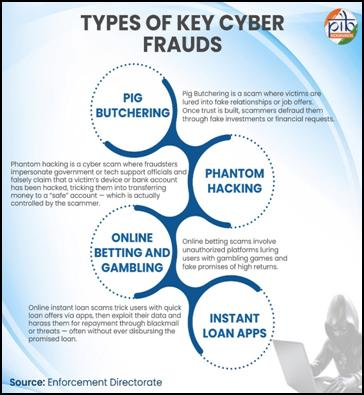
Reasons for increase in Cybercrime
- Rapid Digitalization: With a growing number of individuals and businesses relying on the Internet and digital technologies there are more opportunities for cybercriminals to exploit vulnerabilities.
- Large Internet User Base: India has 95 crore Internet users. With a large population using the internet, there are more potential targets for cybercriminals, making it a lucrative market for cyberattacks.
- Inadequate Cybersecurity Infrastructure: In India the cybersecurity infrastructure is still developing. Many organizations, especially smaller businesses, may not have robust cybersecurity measures in place, making them easy targets for cybercriminals.
- Insider Threats: Insider threats, where employees or individuals with access to sensitive information misuse it for malicious purposes, are a significant concern in India, particularly in the corporate sector.
- Payment Systems Vulnerability: With the rise of digital payments and online transactions, there is an increased risk of financial crimes such as phishing, credit card fraud, and online scams.
- In 2024, India saw UPI (Unified Payments Interface) transactions worth about Rs 20,64,000 crore which is 46 percent of the global digital transactions.
- Low digital literacy: Lower awareness among the general public and digital gaps amongst nations create an unsustainable environment in the cyber domain.
Effects of Cybercrime
- Financial Losses: Cybercrime leads to substantial financial losses for individuals and organizations through theft of funds, fraudulent activities, or the cost of restoring compromised systems.
- National Security Concerns: Cyberattacks with a geopolitical motive pose national security threats. The attacks target government agencies, critical infrastructure, or defense systems, compromising a nation’s security.
- Data Breaches: The unauthorized access and theft of sensitive data compromises the confidentiality of personal and financial information, causing reputational damage and potential legal consequences.
- Disruption of Services: Cyberattacks disrupt essential services and critical infrastructure, impacting businesses, governments, and individuals.
- Loss of Intellectual Property: Businesses suffer from the theft of intellectual property, trade secrets, and proprietary information which undermine competitiveness and innovation, leading to economic repercussions.
Government Steps for Cybersecurity
- Information Technology Act, 2000: Section 43, 66, 70, and 74 of the IT Act, 2000 deal with hacking and cyber crimes.
- Indian Computer Emergency Response Team (CERT-In) issues alerts and advisories regarding latest cyber threats/vulnerabilities and countermeasures to protect computers and networks on a regular basis.
- National Cyber Coordination Centre (NCCC) has been set up to generate necessary situational awareness of existing and potential cyber security threats and enable timely information sharing for proactive, preventive and protective actions by individual entities.
- Cyber Swachhta Kendra (Botnet Cleaning and Malware Analysis Centre) has been launched for detection of malicious programs and provides free tools to remove the same.
- Chakshu Facility: It is a newly introduced feature on the Sanchar Saathi portal that encourages citizens to proactively report suspected fraudulent communications received via call, SMS, or WhatsApp.
- Indian Cyber Crime Coordination Centre (I4C): It was established in 2018 under the Central Sector Scheme within the Cyber and Information Security Division of the Ministry of Home Affairs.
- It provides a framework and eco-system for Law Enforcement Agencies (LEAs) to deal with Cybercrime in a coordinated and comprehensive manner.
- E-Zero FIR Initiative: Launched by the Ministry of Home Affairs (MHA) to enable swift registration and investigation of cyber financial crime cases.
- The system automatically converts cyber financial crimes filed at NCRP or 1930 to FIRs, initially above the threshold limit of ₹10 lakh.
International Measures
- Budapest Convention: It is the 1st international treaty to address cybercrime. India is not a signatory to the treaty.
- Internet Corporation for Assigned Names and Numbers (ICANN): It is a US-based not-for-profit organization for coordinating & maintenance of several databases.
- Internet Governance Forum: It is the United Nations forum for multi-stakeholder policy dialogue on Internet governance issues.
Way Ahead
- India is at the crossroads of digital transformation and cyber threats, where it has become both an iron pillar of progress and a magnet for cyber fraudsters.
- Realising the vision of Digital India, the government’s multi-layered cyber response team is facilitating fraud prevention and disrupting thousands of scam operations.
- Advanced forensics, big data analytics, and indigenous tools have bolstered national cyber resilience.
Source: IE
Next article
World Intangible Investment Report 2026
